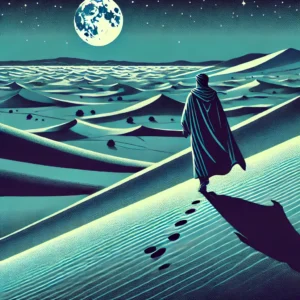
Ibrāhīm al-Kūnī (1948-, Libya) – ʿUshb al-Layl (1997, English trans. Night Grass, 1997) could be seen as a contemporary description of the ṣaʿālīk. Set in the remote regions of the Sahara in a traditional Tuareg society, the main protagonist, Wān Tīhāy, in his pursuit of immortality and wisdom, places himself in opposition to the customary practices of his fellow tribesmen. Examples include his devotion to darkness and his night-time wanderings (in which he presumably communicates with djinns) but also by allowing his third wife, who was a slave, to wear indigo-coloured clothes, which went against the tribe’s colour hierarchy, and his incestuous relationship with his daughter and granddaughter (reference) (also on L: Lust and Sex: Incest and M: Minorities: Tuareg).
Image of ʿUshb al-Layl generated through DALL·E by Desiree Custers
Refrences:
In order of appearance
John Joseph and Henry Rossetti. 2011. “Darkness in the Desert: Traditional and Transgression in Ibrāhīm al-Kūnī’s ‘ʿUshb al-layl’.” JAL 42: 49-66